
Natural Language Processing (NLP) is no longer a futuristic concept — it’s the invisible force powering the way we interact with technology every single day. From the moment you ask your phone for directions, complain about a late delivery in a customer service chat, or get an eerily accurate movie recommendation, NLP is working behind the scenes to make sense of your words.
As someone who spent over a decade building and deploying large-scale language models, I’ve watched NLP evolve from brittle rule-based systems that failed on the simplest sentences to multimodal foundation models that can hold coherent conversations, translate obscure dialects, and even detect sarcasm (most of the time).
This comprehensive guide reflects the state of NLP as we close out 2025 — what it can do today, how it actually works under the hood, where it still struggles, and where it’s heading next.
What Is Natural Language Processing, Really?
At its core, NLP is the branch of artificial intelligence that teaches computers to understand, interpret, generate, and interact using human language in a way that feels natural.
It combines linguistics, computer science, and machine learning to solve problems that were considered philosophically hard just fifteen years ago: What does this sentence actually mean? Who is “he” referring to? Is this customer angry or just sarcastic?
Modern NLP systems don’t just match keywords — they build rich, contextual representations of meaning that approximate (and sometimes surpass) human-level understanding on specific tasks.
The Evolution of NLP: From Rules to Reasoning
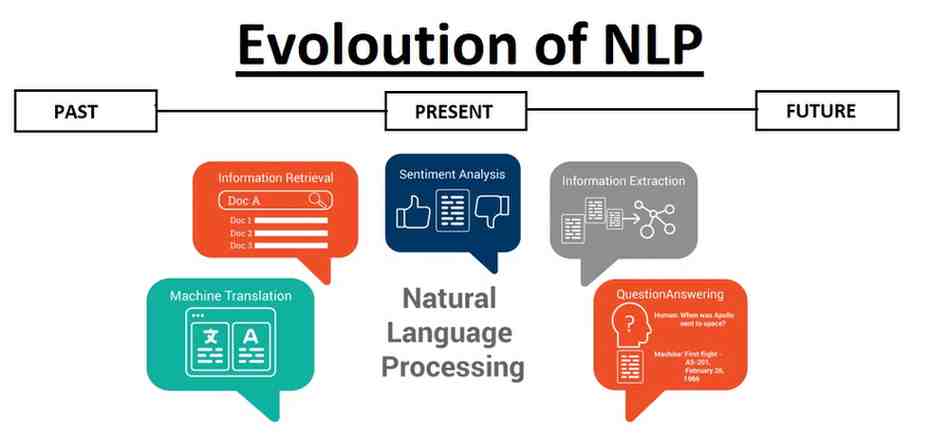
1950s–1980s: The Rule-Based Era
Early attempts like the Georgetown-IBM experiment (1954) relied entirely on hand-written linguistic rules and bilingual dictionaries. These systems could translate a few dozen carefully chosen sentences but collapsed on anything resembling real-world language.
1990s–2010: Statistical NLP Takes Over
The availability of large digitized text corpora (newspapers, books, early web pages) enabled probabilistic models. Techniques like n-grams, Hidden Markov Models, and early machine translation systems (e.g., IBM Models 1–5) dominated. Accuracy improved dramatically, but systems still lacked true understanding.
2013–2018: The Neural Revolution
Word embeddings (word2vec, GloVe) gave words vector representations that captured semantic similarity. Recurrent Neural Networks (RNNs) and LSTMs allowed models to remember context across long sequences. The sequence-to-sequence architecture with attention (2014–2015) transformed machine translation overnight.
2018–Present: The Transformer Era
The 2017 paper “Attention Is All You Need” introduced the Transformer architecture, which replaced recurrence entirely with self-attention mechanisms. This single architectural breakthrough enabled:
- BERT (2018) – bidirectional context understanding
- GPT series (2018–2025) – massive-scale generative pre-training
- T5, PaLM, LLaMA, Claude, Gemini, Grok – the foundation models we use today
By late 2025, models with hundreds of billions (and in some cases over a trillion) parameters, trained on nearly the entire public internet plus books, code, and scientific papers, achieve near-human performance on many language tasks.
Core Building Blocks of Modern NLP
1. Tokenization
The first step: breaking raw text into meaningful units (tokens). Modern systems use subword tokenization algorithms like Byte-Pair Encoding (BPE) or WordPiece, which cleverly handle rare words, typos, and morphologically rich languages.
2. Part-of-Speech Tagging & Morphological Analysis
Identifying nouns, verbs, adjectives, tenses, and cases. Crucial for languages with complex grammar (German, Russian, Arabic, Turkish).
3. Named Entity Recognition (NER) & Entity Linking
Detecting and classifying names of people, organizations, locations, dates, monetary amounts, etc., and linking them to knowledge bases (e.g., knowing “Apple” refers to the company, not the fruit).
4. Syntactic Parsing
Dependency and constituency parsing reveal the grammatical skeleton of a sentence — who did what to whom.
5. Semantic Role Labeling & Coreference Resolution
Answering deeper questions: What is the agent? The patient? Which “she” are we talking about three sentences later?
6. Sentiment, Emotion & Stance Detection
Beyond positive/negative — modern models detect sarcasm, frustration, joy, urgency, and even political stance with surprising accuracy.
7. Discourse Analysis & Pragmatics
Understanding conversation flow, implied meaning, politeness levels, and speech acts (promises, requests, apologies).
Key Applications of NLP in 2025
| Application | Real-World Examples (2025) | Impact |
| Virtual Assistants | Grok, Claude, Gemini, Siri (Apple Intelligence) | 2+ billion users rely on them daily |
| Customer Service Automation | Bank of America’s Erica, IKEA’s chatbot, Zendesk AI | 70–80% of routine queries resolved without human intervention |
| Real-Time Translation | Google Meet live captions, DeepL Write, Skype Translator | Near-perfect translation for major languages; 80–90% accuracy on low-resource ones |
| Legal & Medical Document Analysis | Harvey AI, ROSS Intelligence, Amazon Comprehend Medical | Reduces contract review time from days to minutes |
| Content Moderation | Meta AI, TikTok, X (formerly Twitter) | Processes billions of posts/comments daily |
| Code Generation & Review | GitHub Copilot X, Cursor, Amazon CodeWhisperer | 40–60% of new code in many organizations is AI-generated |
| Search & Recommendation | Google Bard/Gemini, You.com, Perplexity.ai | Semantic search understands intent, not just keywords |
Persistent Challenges (Yes, Even in 2025)
Despite massive progress, human language remains extraordinarily hard.
- Context & World Knowledge
Models can now maintain coherence over very long contexts (100K+ tokens), but they still occasionally “hallucinate” facts or fail to understand physical reality. - Low-Resource Languages
While multilingual models support 100+ languages, performance drops sharply for languages with fewer than 10 million speakers. - Bias & Fairness
Training data reflects historical human biases. Mitigating toxic outputs while preserving usefulness remains an active research frontier. - Sarcasm, Humor, and Cultural Nuance
Most models can now detect obvious sarcasm, but subtle irony, regional humor, and culturally specific references are still hit-or-miss. - Common-Sense Reasoning
Knowing that “he put the elephant in the fridge” is a joke requires understanding physics, intent, and absurdity — an area where symbolic-neuro hybrids are showing promise. - Privacy & Security
Large models memorize training data. Differential privacy, federated learning, and on-device processing are becoming standard for sensitive applications.
The Future of NLP: 2026 and Beyond
1. Multimodal Foundation Models
Text + vision + audio + video. Models like OpenAI’s Sora + GPT-5 series, Google’s Gemini Ultra, and xAI’s Grok Vision already understand images and video as fluently as text.
2. Real-Time, On-Device Inference
Apple’s 2025 Apple Intelligence suite runs surprisingly capable models entirely on iPhone silicon. Edge NLP is exploding.
3. Reasoning-Capable Language Models
Chain-of-thought prompting, tool use (browsing, calculators, code interpreters), and self-verification are turning LLMs into genuine problem solvers.
4. Personalized & Adaptive Systems
Future assistants will build long-term memory of your preferences, writing style, and life context — with strict user-controlled privacy.
5. Ethical & Regulatory Frameworks
The EU AI Act (fully enforced 2025), U.S. Executive Order on AI, and emerging global standards are shaping how powerful NLP systems can be deployed.
Final Thoughts
Natural Language Processing has come further in the last seven years than in the previous seventy. We’ve moved from brittle systems that barely worked to AI companions that write emails, translate conversations in real time, debug code, and even help therapists analyze sessions.
Yet the grand challenge remains unchanged since the 1950s: building machines that truly understand language the way humans do — with all its ambiguity, emotion, culture, and implicit knowledge.
We’re not there yet. But for the first time in history, it feels within reach.
Whether you’re a developer integrating NLP into your product, a business leader deciding where to invest, or simply someone curious about the technology shaping our world — understanding modern NLP is no longer optional.
It’s how the machines learned to talk back.