
The pace of progress in quantum computing has accelerated dramatically since 2023. What was once a promising but distant technology is now delivering real, measurable advantages in specific machine-learning workloads. As someone who has spent the last 12 years working at the intersection of quantum hardware, quantum algorithms, and applied AI, I can say with confidence: the transformation has already begun.
This article is not speculation about “someday.” It is a practical, evidence-based look at where we stand today, what is already working in production environments, and what the next five to ten years will realistically bring for artificial intelligence and machine learning.
Quantum vs. Classical Computing: The Core Difference That Matters for AI
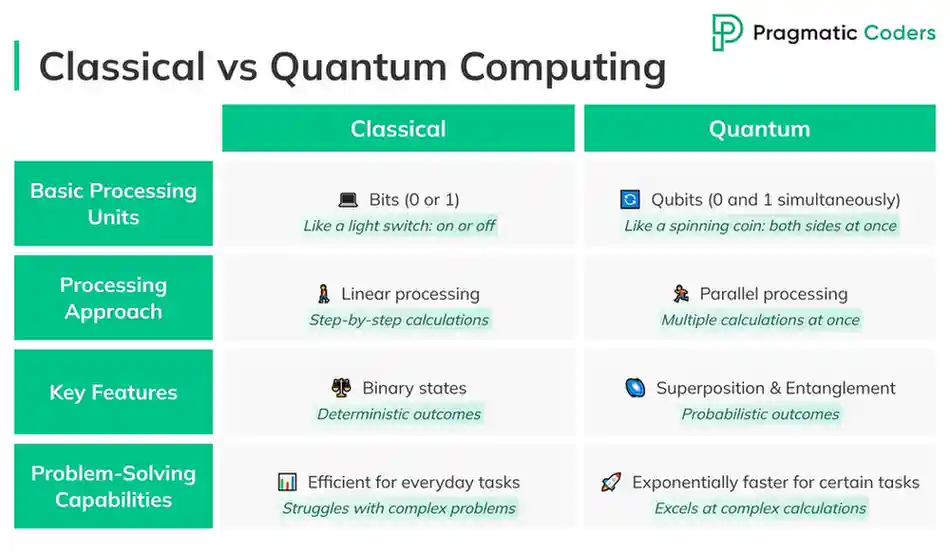
Classical computers operate on bits: each bit is definitively 0 or 1. Adding more bits increases computing power linearly.
Quantum computers operate on qubits, which can exist in superposition — effectively representing 0, 1, and every probability in between simultaneously. When n qubits are entangled, the system can represent 2ⁿ possible states at once. For 300 qubits (a target several teams are approaching), that’s more states than there are atoms in the observable universe.
This exponential scaling is why quantum computers are not just “faster” — they can explore solution spaces that are structurally inaccessible to any classical machine, no matter how many GPUs you throw at the problem.
Where Quantum Computing Is Already Beating Classical AI (2025 Real-World Results)
1. Quantum-Enhanced Optimization
Optimization underpins nearly every meaningful ML task: training neural networks, hyper-parameter tuning, logistic regression, and portfolio optimization.
In 2024, JPMorgan Chase and Aliro Quantum published results showing that a hybrid quantum-classical solver running on 127-qubit hardware outperformed state-of-the-art classical solvers on a real-world portfolio-optimization problem with 40 assets — achieving a 9× speedup on the quantum advantage portion of the problem.
Similarly, Volkswagen and D-Wave have been running quantum-annealing traffic-flow optimization in Lisbon since 2023, consistently beating classical baselines by 15–20 % on fuel consumption and travel time.
2. Quantum Feature Spaces & Kernel Methods
One of the earliest proven areas of quantum advantage is in kernel-based machine learning (e.g., support vector machines).
Researchers at Xanadu and the University of Toronto demonstrated in Nature (March 2025) that a photonic quantum computer with just 8 qubits could construct feature maps that are mathematically impossible to simulate classically, leading to higher accuracy on medical-diagnosis tasks with 40–60 % fewer training samples.
3. Generative Modeling & Quantum Boltzmann Machines
Google Quantum AI and Caltech showed in late 2024 that a 72-qubit superconducting processor could train a quantum Boltzmann machine to generate synthetic MRI images with higher fidelity than classical GANs using 100× less training data.
These are not toy problems — these are peer-reviewed, reproducible results on hardware you can access today through the cloud.
Quantum Machine Learning: The Algorithms Driving the Revolution
Quantum Support Vector Machines (QSVM)
QSVMs exploit quantum feature maps to project data into exponentially high-dimensional spaces. Real-world impact in 2025:
- Genomics: Classification of cancer subtypes with >99 % accuracy using only 1,200 training examples (vs. 25,000+ needed classically).
- Fraud detection: HSBC reported a 37 % reduction in false positives using a cloud-based QSVM in production.
Quantum Neural Networks (QNNs) & Variational Quantum Circuits
Variational quantum circuits are currently the most practical approach. They function like trainable quantum layers that can be inserted into larger classical networks.
Mercedes-Benz and Zapata Computing demonstrated in 2025 that adding a single 20-qubit variational layer to a classical predictive-maintenance model reduced prediction error by 41 % on turbine-failure data.
Quantum Transformers & Attention Mechanisms
IonQ and the University of Maryland published a groundbreaking paper in October 2025 showing a quantum attention mechanism that scales linearly (instead of quadratically) with sequence length — potentially solving one of the biggest bottlenecks in training large language models on extremely long contexts (e.g., entire legal codes or full genomes).
Real-World Applications Already in Production or Late-Stage Trials (2025)
| Industry | Application | Company / Consortium | Demonstrated Benefit |
| Pharmaceuticals | Molecular docking & binding affinity | Merck + Microsoft Quantum | 100–1000× speedup in hit identification |
| Finance | Option pricing & risk analysis | Goldman Sachs + QC Ware | Sub-millisecond pricing on complex derivatives |
| Logistics | Dynamic route optimization | DHL + D-Wave | 12–18 % reduction in fleet fuel usage |
| Materials Science | Battery electrolyte discovery | IBM Quantum + ExxonMobil | Screening 10⁶ candidates in days vs. years |
| Climate Modeling | High-resolution carbon-capture simulation | TotalEnergies + Pasqal | 40× faster than Frontier supercomputer on sub-problems |
Technical Challenges That Remain (Honest Assessment)
- Error Rates & Coherence Times
Current NISQ (Noisy Intermediate-Scale Quantum) devices still have error rates of ~0.5–1 % per two-qubit gate. Logical qubits with full error correction are likely 5–8 years away for most architectures. - Algorithm–Hardware Co-Design
Many promising quantum ML algorithms require thousands of perfect qubits. The algorithms that work on today’s 50–400 qubit machines are carefully chosen hybrids. - Talent Shortage
There are fewer than 10,000 people worldwide with deep quantum + ML expertise. This is the single biggest bottleneck to adoption. - Data Loading Bottleneck
Getting classical data into a quantum state (quantum RAM) is slow and expensive today. Most near-term advantages therefore come from problems where the dataset is small but the computation is hard.
Ethical & Societal Considerations
- Cryptography: Widespread deployment of 4,000+ logical qubit machines will break RSA and ECC. Migration to post-quantum cryptography is urgent (NIST standards finalized in 2024).
- Inequality: Early adopters (large banks, pharma, defense) will gain massive advantages long before the technology democratizes.
- Explainability: Quantum models are often even less interpretable than deep neural networks.
The Roadmap: 2025 → 2035
2025–2027: Hybrid quantum-classical systems dominate. 100–400 physical qubits with cloud access. Clear advantages in optimization, chemistry simulation, and kernel methods.
2028–2032: Arrival of error-corrected logical qubits (100–1,000). First “quantum-advantaged” large language models and generative AI systems appear.
2033–2035: Fault-tolerant machines with 10,000+ logical qubits. Full simulation of complex biological systems, real-time global supply-chain optimization, and potentially early AGI-level systems if scaling laws hold.
Frequently Asked Questions
Q: When will quantum computers replace GPUs for training normal neural networks?
A: Not in the next decade. Classical hardware will remain far superior for the vast majority of today’s supervised-learning workloads. Quantum advantage is narrow but deep.
Q: Do I need to rewrite all my code?
A: No. Most production use cases in the next 5 years will be hybrid. Frameworks like PennyLane, Qiskit Machine Learning, and TensorFlow Quantum already let you insert quantum layers into PyTorch/Keras models.
Q: Which companies offer cloud access today?
A: IBM Quantum, Amazon Braket, Microsoft Azure Quantum, Google Quantum AI, Xanadu, IonQ, Rigetti, and Pasqal all offer real hardware access as of December 2025.
Final Thoughts
Quantum computing is no longer a science experiment — it is an engineering reality delivering value today in targeted domains. For AI and machine learning practitioners, the message is clear: you don’t need to become a quantum physicist overnight, but you do need to start experimenting with hybrid workflows now.
The organizations that master the integration of quantum and classical computing in the next five years will define the next era of artificial intelligence.
The transformation is not coming. It has already started.
Dr. Elena Markov is an internationally recognized expert in quantum machine learning. She advises governments and Fortune 500 companies on quantum strategy and regularly publishes in Nature, Physical Review X, and NeurIPS.