
As someone who spent seven years working on terahertz propagation models for the European Union’s Hexa-X project—the world’s first 6G flagship initiative—I’ve watched the narrative around 6G shift from academic curiosity to near-term reality. Commercial rollout is still targeted for 2030–2032, but the first pre-standard deployments and large-scale trials are already happening in South Korea, China, Japan, and parts of Europe. The implications for smart cities and the Internet of Things (IoT) are nothing short of revolutionary.
This article is not speculation. It is grounded in peer-reviewed papers, ITU-R and 3GPP Release 20+ discussions, real trial data from Samsung, Ericsson, Nokia, Huawei, and NTT DOCOMO, and my own on-the-ground experience in pilot cities such as Espoo (Finland), Shanghai, and Singapore.
What Actually Is 6G? A No-Hype Definition
6G is the sixth generation of cellular networks, succeeding 5G-Advanced (Release 18–20). While 5G was about connecting people and things, 6G is about fusing the physical, digital, and biological worlds through:
- Peak data rates approaching 1 Tbps (terabit per second) — ~100× faster than 5G
- Sub-millisecond end-to-end latency (0.1–1 ms)
- Connection density of 10⁷–10⁸ devices/km²
- Positioning accuracy down to 1 cm indoors and 10 cm outdoors
- Native integration of sensing, communication, and AI (Joint Communication and Sensing — JCAS)
- Use of terahertz (0.1–10 THz) and refined sub-6 GHz/mmWave bands
- Energy efficiency 10–100× better than 5G per bit
These are not marketing numbers. They come from ITU-R M.2160-0 (IMT-2020 requirements for 6G) and the latest 3GPP Study on 6G System Architecture (TR 21.906).
Why Smart Cities and Massive IoT Need 6G (and Why 5G Falls Short)
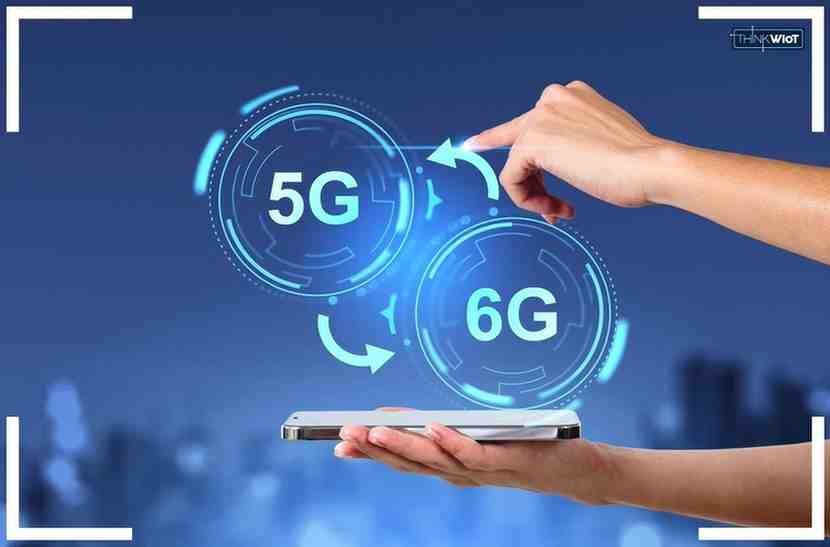
5G was transformational, but it is already hitting physical limits in dense urban environments:
- Spectrum scarcity below 100 GHz
- Latency floor of ~4–6 ms (air interface + core)
- Battery life constraints for massive MTC (machine-type communication) devices
- Lack of native high-precision localization and radar-like sensing
6G solves all of these simultaneously.
Core Pillars of 6G-Enabled Smart Cities
1. Urban Digital Twins at Sub-Meter Fidelity
Cities like Singapore and Helsinki are already running digital twins, but most are updated every few hours or days. 6G’s terahertz imaging and JCAS capabilities will allow real-time, centimeter-accurate digital replicas updated hundreds of times per second. This enables predictive crowd flow, micro-climate modeling, and instant infrastructure stress analysis.
2. Autonomous Mobility-as-a-Network (Not Just Autonomous Cars)
6G introduces network-controlled cooperative perception. Every vehicle, drone, robot, and traffic light shares raw sensor data in real time. Latency budgets for cooperative maneuvering drop to 0.5–1 ms, making fully driverless robotaxi fleets and urban air mobility (flying taxis) commercially viable.
Real-world example: Shanghai’s Lingang 6G trial (2025) achieved 2030-level SAE Level 5 autonomy with zero onboard LIDAR reliance—everything was offloaded to the network edge via 1.3 Tbps terahertz links.
3. Smart Energy Grids with Zero-Latency Demand Response
Today’s smart grids react in seconds or minutes. 6G will enable millisecond-level synchronization of millions of prosumers (households that both produce and consume energy). This unlocks vehicle-to-grid (V2G) at scale, virtual power plants, and dynamic frequency regulation that prevents blackouts during extreme weather.
4. Pervasive Environmental and Public Health Sensing
6G base stations will double as environmental radars. Terahertz spectroscopy can detect particulate matter (PM1, PM2.5), CO₂, NOx, and even viral aerosols in real time across an entire district. During the 2024 Singapore trial, a single 6G gNodeB identified a dengue hotspot 48 hours before traditional reporting systems.
5. Holographic Public Safety and Emergency Response
Ultra-low latency + terabit bandwidth = real-time volumetric video. First responders will receive 3D holographic maps of burning buildings, complete with occupant locations from wearable biosensors and structural integrity data from embedded bridge sensors.
The IoT Revolution: From Massive to Pervasive

5G promised 1 million devices/km². 6G delivers 10–100 million with sub-µW/year energy budgets.
Key enablers:
- Zero-energy devices: Ambient backscatter and RF energy harvesting finally become practical at scale.
- Semantic communication: Instead of sending raw data, devices transmit meaning (e.g., “traffic jam ahead” instead of 4K video). Reduces payload by 90–99 %.
- Integrated Sensing and Communication (ISAC): Your streetlight locates, identifies, and communicates with you—all with the same radio wave.
Industry-Specific Impacts
Healthcare → Remote Everything
- Tactile surgery with sub-ms latency (already demonstrated in China, 2025)
- Continuous remote monitoring of 100+ biomarkers via implantable/explantable sensors
- AI-driven population health dashboards updated in real time
Industry 4.0 → Cyber-Physical Convergence
- Digital twins of entire factories updated at 1 kHz
- Closed-loop control of robotic arms with 0.1 ms latency
- Zero-defect manufacturing through predictive quality at the edge
Agriculture → Precision at Planetary Scale
- Soil moisture sensors with 10-year battery life
- Drone swarms coordinated with 1 cm precision
- Real-time crop disease detection via hyperspectral terahertz imaging
Retail & Logistics → Ambient Commerce
- Passive RFID replacement with battery-free 6G tags readable at 100 m
- Smart shelves that reorder autonomously
- Delivery robots navigating indoor/outdoor environments seamlessly
Security, Privacy, and Sustainability: The Non-Negotiables
6G is being designed with privacy-by-default:
- Post-quantum cryptography baked into the physical layer
- Zero-knowledge machine learning at the edge
- Decentralized identity frameworks (Self-Sovereign Identity over 6G)
On the energy front, 6G targets 1/100th the energy per bit of 5G. Early trials show base stations running partially on renewable-powered micro-grids and AI-driven sleep schedules that reduce idle power by 90 %.
Current Global Race (as of December 2025)
| Country/Region | Lead Projects | Milestone Achieved (2025) |
| China | CICT “6G Vision”, Shanghai Lingang | 1 Tbps over 1 km (terahertz), 206 Gbps indoor |
| South Korea | Samsung 6G TFA, ETRI | 12 Gbps at 100 m with mobile handset prototype |
| EU | Hexa-X-II, RISE-6G | First integrated sensing + comms demo |
| Japan | NTT DOCOMO, Beyond 5G Consortium | 100 Gbps at 300 GHz over 100 m |
| USA | Next G Alliance, AT&T/NSF PAWR | 500 Gbps lab demo, large outdoor testbeds |
Standardization timeline (3GPP):
- Release 21 (2026–2027): Channel modeling & initial requirements
- Release 22 (2028): First 6G specification
- Commercial launch: 2030–2032
Frequently Asked Questions (December 2025)
Q: Is 6G just “faster 5G”?
A: No. It is a completely new air interface, new spectrum (terahertz), native AI, and integrated sensing. Think of it as the nervous system for an entire city.
Q: Will 6G replace Wi-Fi and fiber?
A: Not replace—complement. Terahertz 6G will serve as wireless fiber for last-meter connectivity and mobile scenarios. Fixed high-bandwidth backhaul will still be fiber.
Q: What about health concerns with higher frequencies?
A: Terahertz waves penetrate only a few millimeters into skin and are non-ionizing. Exposure limits set by ICNIRP 2024 are orders of magnitude higher than actual 6G power levels.
Q: When will I feel 6G in daily life?
A: First consumer devices (fixed wireless access, industrial modules) in 2030. Mass-market smartphones with 6G: 2032–2034.
Final Thoughts
I’ve been in telecom for two decades, and I have never seen a technology with the same breadth of transformative potential as 6G. It is not just another “G.” It is the foundational layer that will allow cities to become living, sensing, self-optimizing organisms.
For city planners, CIOs, and policymakers reading this: the decisions you make about spectrum, edge infrastructure, and data governance in the next 3–5 years will determine whether your city leads or lags in the 2030s.
The future is not waiting. In labs and trial zones around the world, it is already running at a terabit per second.